Showing posts with label Cuban food. Show all posts

11/22/2006

pastelitos de guayaba - guava pastry


I seems to be a generally held truth that love fades. Long relationships - I am often told - develop from passionate love to friendship, collaboration, team-work and habit as one copes with every-day preoccupations together. Even though one can find comfort and security in a long-time partner life together gets a bit boring and one is said to miss the adventures and excitements of the initial crush. This, I believe, is just wrong.

The thing is all types of love has to be earned and deserved. One can never take a partner for granted.

I'm sure everyone has their own ways to make their partner fall in love with them again...and again. This is one of my "love potions" (and it works every time!).

In Havana pastelitos de guayaba are sold in the streets for 2 Cuban pesos a piece and they have been one of my husbands favorite treats for as long as he (and I) can remember. So, when a Cuban friend of mine gave me half a kilo of guava paste as a good-by gift when I was leaving Havana a couple of weeks ago I just knew what to do with it.

I had been in said city doing fieldwork for my thesis for three months while my husband was in Sweden studying and as if reading my thoughts my friend handled me the package with the words: "When you two get up from bed after your reunion you can recover some of that energy lost by eating this..."

Well, the half-kilo of guava paste will make lots of pastelitos so I guess I'm guaranteed a long and happy marriage!


This Cuban brand of guava paste is actually rather known, at least in other Spanish-speaking countries. My mother, for example, remembers it from her childhood in the Canary Islands. I guess the lovely lay-out of the package hasn't changed either...

I didn't make my own short pastry to make these but they turned out great anyways!

---

one 450 g rich short pastry-sheet
some guava paste

The short pastry-sheet I bought has rather thick so i had to roll it a little bit thinner. This should, however, not be made with leaf-thin dough. Cut the dough in squares, put some guava paste in the middle of each square and fold the corners to the middle. Wet the corners with some water as you fold to make them stick. Put on a baking sheet. Beat an egg and paint the pastry with it. Bake in 225 degrees C for 15 minutes.

11/17/2006

cuban coffee on a rainy friday morning


Thank the divinities for Cuban coffee! I'm actually not very fond of coffee and only drink it once or twice a week. When I drink it I'm extremely picky and the only one I really, really like is Cuban coffee.

Besides sugar, tobacco and rum, coffee must be what Cuba is known for internationally (OK, I guess music and communism are pretty known features too). Most people in Havana buy the rationed subsidised coffee sold by the state and, when running out of this, the one sold "in the street" (ie. the black market). Up until recently it was sold ground and mixed with roasted yellow peas in order to make the precious coffee last more. The only place you could find pure coffee was in stores operating in dollars or the Cuban equivalent to dollar and most people has very limited access to this currency...

Not even a year ago the Cuban state raised the prize of the rationed subsidized coffee and claimed this new expensive coffee was pure, without peas. According to some the coffee still have peas in it but what do I know...

I've always liked the mixed coffee best. It seems like the roasted and ground yellow peas gives it more body... But I can tell you I'm pretty much the only one with this preference. The pure coffee sold in the Cuban equivalent to dollars is considered of superior quality and when I voice my preference for mixed coffee most Cubans just roll their eyes: "crazy foreigner..."

Last time I went to Havana I found the famous Cuban brand Monte Rouge. No one I asked had ever tasted it but the rumor tell this is the best Cuban coffee. It it said to belong to Raúl Castro (Fidel Castros brother) and has also given its name to the best contemporary Cuban underground short film (where it also features). A famous brand indeed!
I had never seen whole coffee beans for sale in Havana so I was lucky to find these beautiful aromatic ones. Ground at home, made real strong in our classic moka espresso maker and mixed with plenty of sugar (Cuban style) it makes a rainy morning feel just fine!

stew with white beans and chorizo


I made this dish in Cuba - a country where a meal without rice and beans hardly is considered a meal at all - on a housewife-y Sunday specked with laundry (hand-washed!) and cleaning. It certainly revitalised why poor self after such a "hell-on-earth" experience. The white beans are not as popular in Havana as black or kidney beans but the Cuban friend I shared house with at the time loved the stew. The rich, a little hot and smoke-y flavour given by the chorizo contrast nicely with the mild neutral flavours of the beans and caladium and the sweetness of the pumpkin.


My plan was to make this stew with some beautiful black eyed beans I found in a farmers market. I bought 1lb (about 500g) and planned to use half of it on making this stew and the other half on a cold salad with raw onions, sweet pepper and vinegar. But things don't always turn out as one plans. Specially not in Cuba where the only thing one is said to be able to count on is the need to improvise. Planning is loosing one's time since reality there (for various reasons) seems to be particularly hard to predict. So: when I opened the little plastic bag the beans were full of grubs. There wasn't a bean without a tiny and absolutely circular hole in it and the little insects responsible for the holes jumped all over. I had to throw away everything and go buy white beans instead since black eyed beans are very rare in Havana. But - and this is also held as a general truth in the largest of the Antilles - tings turned out well in the end anyways! I suppose I'll make the same stew with black eyed beans some other day.


As always with stews they are even tastier a few hours after being made (am I the only person who prefer my food luke-warm?) or reheated the day after. Perfect to make on a Sunday when you have lots of time and then take with you in the lunch-box on Monday!


Eat it with rice and a nice salad. I particularly like the combination of chorizo with avocado so - if I had had some ripe avocados at home when I made it - i would have had a salad with avocados. And if I hadn't been so hungry after all the laundry and cleaning I might have had time to make some tostones too. As it was I and my friend just ate it with white rice...


---


Judias con chorizo - Stew on white beans and Chorizo

(serves approx. 4 persons)

1/2lb (250g) white beans
1 big onion
4-5 garlic cloves
1 red sweet pepper
2 medium sized caladiums (or potatoes)
1/2 small pumpkin
1 1/2 small chorizo (the sort that is supposed to be cooked)
1 1/2 dl of wine or sherry
1 tbsp tomato paste
cumin
salt
sugar


Cook the beans until soft.

When the beans are almost ready it's time to prepare the rest of the ingredients:

Chop garlic, onions and pepper and fry a couple of minutes in oil. '

Peel and cut the caladium (or potatoes) and the pumpkin in big chunks (if the peaces are too small they will disintegrate when cooked).

Peel the chorizo (ordinarily they come with a "skin" that has to be removed) and cut in small cubes.

Add all the ingredients when the beans are soft and season with wine, tomato paste, cumin, salt and sugar.

Remember that the chorizo can be rather salty so be careful with the salt.

Ok, so, now comes the most difficult step. As in all Cuban bean stews it has to "cuajar"* which basically means it has to boil gently (without pressure but under a lid if you used a pressure cooker to soften the beans) until it has become thick and creamy and all the tastes have come fourth. If you have ever eaten a stew that has "cuajado" you will never want to eat a "watery" stew ever again! I let myself be guided by the sound of the boiling, the feeling of the stew as I stir it and the taste of the sauce. It's better to let it cook a few minutes too much than to end up with a watery, tasteless thing. In other words: don't panic about reducing the cooking time to preserve vitamins. That's not the priority here! Just be patient in a laid-back Caribbean way and everything will turn out just nice!


---

Specific notes on this stew:


I do NOT recommend you to skip the sugar! In my taste (and I'm not especially fond of sugar) white beans, just like black beans and black eyed beans, need a little sugar as it brings fourth their wonderful taste.


If you are vegetarian/vegan I guess you can exclude the chorizo but since the smoke-y flavour is the fun part of this dish you may want to substitute the chorizo with something vegetarian with a smoked flavour: sesame-oil? heavily roasted nuts? some smoked cheese crumbled over the served stew? Once I burnt my beans (making a totally different dish) and the result was a smoked taste...kind of... Anyway: be creative but don't just exclude the chorizo, replace it! (And please mail a post about the result here!)

---


General notes on Cuban bean stews:


Every country seems to have its own customs when it comes to boiling beans. In some countries one let the beans soak in water a couple of hours and then put them on the stove. In other countries (as in Cuba) one skip the soaking completely. Some use a regular pot while others use a pressure cooker. Some (like my parents) even put a regular pot with beans and water in the oven and let it boil slowly during the night. Choose your regular way and use a large pot, lots of water and NO SALT! The salt prolongs the time it takes for beans to soften.


Garlic and onion (and sometimes sweet pepper) fried in oil is called "sofrito" in Cuba and is used in a large variety of dishes, for example in bean stews, tomato sauces or ringled over "dry food" such as fufú, mashed caladium, boiled cassava or big chunks of boiled pumpkin. Be generous with the amount of oil if you want to be authentic, in Cuba one eats with a lot of fat! I suppose olive oil is the best choice but in Cuba that's very (VERY!) expensive so I used sunflower oil.


I haven't said anything about how much time it takes neither for the beans to soften or the stew to "cuajar". That's because it depends heavily on the quality of the beans. If your beans take an eternity to soften my mother-in-law has an advice for you: add a fork to the pot! I am unable to understand what that was to do with it but then again I'm only a beginner when it comes to Cuban cooking!


------------

*My dictionary gives the following translation to the verb "cuajar": "m (zool.) rennet bag; va to curd, to curdle, to coagulate, to thicken, to jelly; to overdeck; (coll.) to please, to suit; vn (coll.) to jell, take shape; (Am.) to prattle; vr to curd, to curdle, to coagulate; to thicken, to jelly; to sleep sound; (coll.) to become crowded"


I guess "to thicken" would be the correct translation here although I also like "to please, to suit and to take shape". This is an essential word in Cuban cooking and loaded with cultural meaning! (Yes, I happen to be an anthropologist in the making...)

10/24/2006

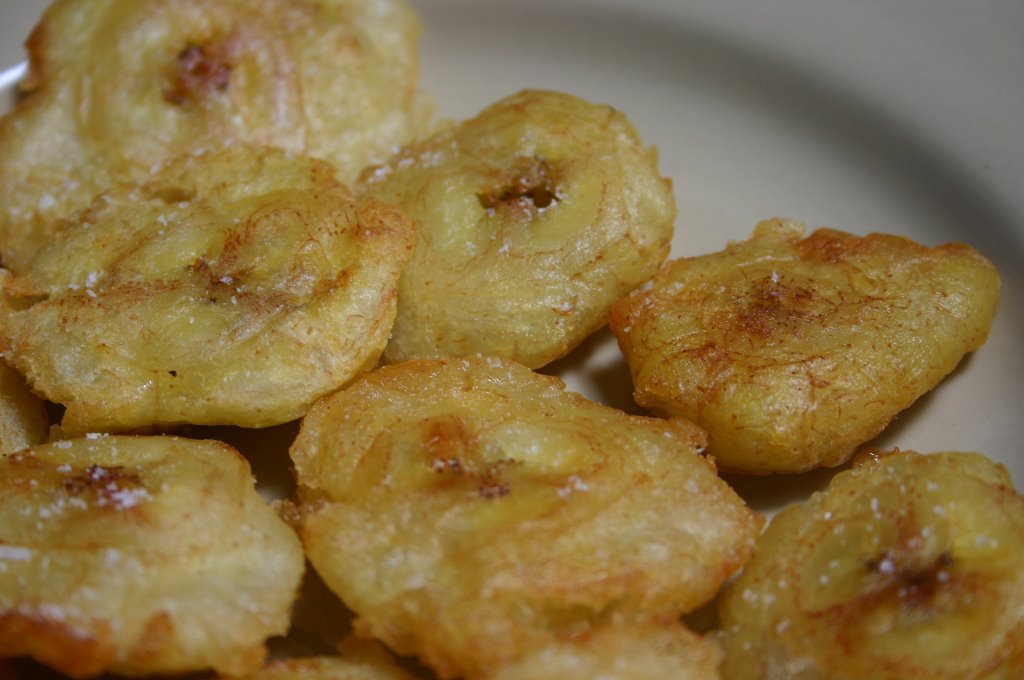
tostones - fried green banana


My English isn't exactly perfect so I have a question for you: Isn't the difference between "banana" and "plantain" that "bananas" are more often than not eaten raw and ripe, as a fruit, and "plantains" are essentially eaten cooked in some way (more or less like a tuber) and used green as well as ripe? Oh well, that's the way I will be using the two words here anyway...

In Cuba there are various sorts of both bananas and plantains. "Plátano fruta" (fruit banana) is the regular banana known to us Europeans. (Although I must say that the flavour of the imported bananas is hopelessly poor.) "Plátano manzano" (apple banana) is another kind of banana. It is much smaller than the "plátano fruta" and has a faint hint of acid in the taste, hence the reference to apples. Wonderful!

Among the plantains there is "plátano macho" (male banana!) and "plátano burro" (donkey banana). The former is the one I've seen on sale in Sweden. In Havana it is considered the best plantain to make tostones, fufú (puré) or use in soups and stews etc. "Plátano burro" is much cheaper in Havana but I havn't been able to find it in Sweden. It is considered ideal for "compota", baby-food made of the ripe bananas, it can however be used as an excelent subsitute for "plátano macho".

Today's entry is devoted to tostones. If there exists something like a national side dish this is the one for Cuba! It also happens to be my preferred dish when it comes to plantains! Make a lot since it's hard not to eat the first batch as you prepare the second one...

I made these in Havana using plátano burro.

---

Tostones

Trim both ends of the green or semi-ripe plantains. Cut in slices (aprox. 2-3cm) and peel. The easiest way to peel is to make a cut and then use the knife to pull the hard skin off the plantain.

Fry the slices in oil (not olive oil but something with a more neutral taste, like sunflower oil) until they get golden. Put the plantains on a plate but don't remove the frying pan from the stove.

Fold a paper (newspaper or normal paper) and lay one slice of plantain on it at a time. Fold the paper over the slice and press with your hands and mash the slice. Put back in the frying pan. Fry until it gets a nice color.

Put some salt on your tostones and enjoy as a side dish with almost anything: rice and beans, your favorite meat dish or a tasty soup!